
Artificial intelligence is becoming one of the biggest topics in retail analytics. Brands and retailers are looking for faster ways to understand performance, predict demand, identify risks, and make better decisions across products, stores, channels, and partners. AI has the potential to transform how teams work with retail data, but there is one important truth that often gets overlooked: AI is only as useful as the data behind it.
Retail teams do not need AI for the sake of AI. They need better visibility, faster insights, and more reliable ways to acton information. If the underlying data is incomplete, inconsistent, delayed, or fragmented, even the most advanced algorithm will struggle to produce insights teams can trust.
That is why clean data matters more than the algorithm. Before AI can help brands and retailers make better decisions, the data foundation needs to be accurate, standardized, and connected.
For retail analytics, this is especially important because data often comes from many different sources. Sales, inventory, sell-through, POS, product, store, channel, and vendor data may all live in different systems or arrive in different formats. Without a unified foundation, AI cannot deliver its full value.
Why AI Is Becoming More Important in Retail Analytics
Retail is moving faster than ever. Product trends change quickly, inventory windows are tighter, and teams need to make decisions with more complexity and less time. Brands and retailers are expected to understand performance across stores, e-commerce, marketplaces, wholesale partners, regions, and product categories.
Traditional reporting can show what happened, but teams increasingly need to understand what is likely to happen next. They want to anticipate stock-outs, identify slow-moving products earlier, detect demand shifts, and improve forecasting. This is where AI can become valuable.
AI can help retail teams process large amounts of data, identify patterns, and surface insights that may not be obvious in standard reports. It can support more proactive decision-making by helping teams detect risk, prioritize opportunities, and understand performance across many variables at once.
But AI does not replace the need for strong data management. In fact, it makes data quality even more important. The better the data foundation, the more useful AI-driven insights can become.
The Problem with Fragmented Retail Data
Retail data is often fragmented by nature.Brands may receive sales and inventory data from multiple retail partners, each with its own file formats, reporting timelines, naming conventions, and product structures. Retailers may manage vendor data, store performance, and reporting workflows across different internal systems.
This fragmentation creates challenges for any kind of analysis, but it becomes an even bigger issue for AI. If data is inconsistent, AI models may struggle to interpret it correctly. If product information is not standardized, performance comparisons may be unreliable. If reporting periods do not align, trend analysis may be misleading.
For example, one retailer may report sales by SKU and store, while another may provide only summarized product-level data.One file may use one product name, while another uses a different naming convention. One system may update weekly, while another updates on a different schedule. These inconsistencies make it harder to build reliable analytics.
Before AI can generate useful recommendations, the data needs to be cleaned, aligned, and standardized. Without that step, teams may end up with faster analysis, but not necessarily better decisions.
Why Clean Data Matters More Than the Algorithm
Algorithms can identify patterns, but they need accurate information to work from. If the data foundation is weak, the output will be weak too. This is why clean data matters more than the algorithm in retail analytics.
Clean data means that information is accurate, complete, consistent, and usable. It means that sales and inventory data is structured in a way that teams can trust. It means product, store, retailer, and channel information can be compared clearly across the business.
When retail data is clean, AI can help teams identify meaningful patterns. It can detect products that are gaining momentum, flag inventory risks, support demand forecasting, and highlight performance anomalies. When data is messy, the same AI outputs may be confusing, inaccurate, or difficult to act on.
For brands and retailers, the goal is not simply to introduce AI into the workflow. The goal is to create insights that improve performance. That starts with reliable data.
AI Needs Context, Not Just Data Volume
There is often an assumption that more data automatically leads to better AI. In reality, more data is only helpful if it is relevant, structured, and contextual.
Retail performance is influenced by many factors, including inventory availability, store location, product visibility, timing, promotions, pricing, seasonality, and channel mix. If AI is only looking at basic sales data without context, it may miss the real reason behind performance changes.
For example, a product with low sales may appear to be underperforming, but the actual issue could be limited inventory or poor allocation. A product with high sell-through may seem like a success, but it could also mean that stock was too shallow and demand was missed. A sudden drop in sales may be caused by a stock-out rather than a change in consumer demand.
This is why AI in retail analytics needs connected data. Sales data becomes more valuable when it is analysed alongside inventory, product, store, retailer, and channel-level information. The more context available, the more useful the insight becomes.
The Role of Unified Retail Data
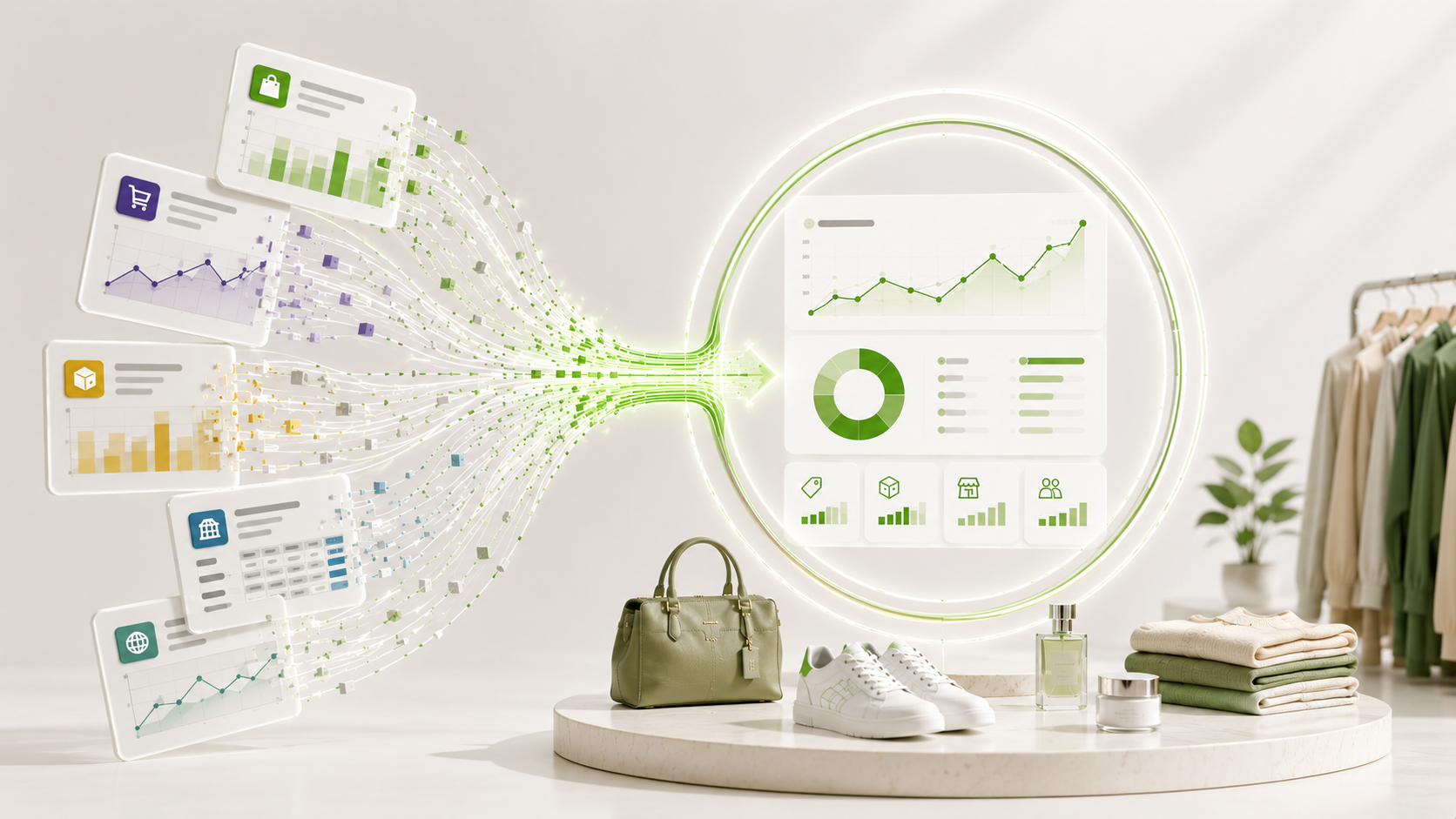
Unified retail data is the foundation for more useful AI-driven analytics. When sales, inventory, product, store, channel, and retailer data are standardized in one environment, teams can analyse performance with more consistency and confidence.
For brands, unified data makes it easier to compare performance across retail partners. It helps teams understand which products are selling, where inventory is moving, which accounts are driving growth, and where risks may be emerging.
For retailers, unified data supports more consistent vendor reporting, better performance visibility, and stronger collaboration with brand partners. It creates a clearer structure for sharing insights and managing data across the retail ecosystem.
For AI, unified data creates a stronger foundation for pattern recognition and predictive analysis. Instead of working from disconnected files, AI can analyse performance across a more complete and reliable data set.
How AI Can Support Retail Decision-Making
When the data foundation is strong, AI can support retail decision-making in several valuable ways. It can help teams identify trends earlier, detect unusual performance patterns, and prioritize the areas that need attention.
AI can support inventory planning by highlighting products that may be at risk of stock-outs or overstock. It can help teams identify where demand is increasing and where inventory may need to be adjusted. It can also support forecasting by using historical and current performance signals to anticipate future needs.
AI can also improve sell-through analysis by helping teams understand which products are moving faster than expected, which are slowing down, and which may require action. Instead of manually searching through reports, teams can be guided toward the most important insights.
For retailers and brands, this can lead to faster, more confident decisions. But again, the value depends on the quality of the data. AI can only support decision-making if the information behind it is reliable.
Why AI Should Enhance Human Decision-Making
AI should not replace retail expertise. It should enhance it. Merchandising, planning, sales, and retail teams bring context that algorithms alone cannot fully understand. They know the business, the product, the retailer relationships, and the commercial priorities.
The best use of AI is to help teams work faster and focus their attention. AI can surface patterns, flag risks, and highlight opportunities, but human teams still need to interpret the insights and decide what action to take.
This is especially important in wholesale and retail collaboration. A recommendation may suggest that a product needs replenishment, but the final decision may depend on retailer strategy, production timelines, seasonality, or account priorities. AI can support the conversation, but it should not remove the human judgment behind it.
Clean, unified data allows AI to become a helpful decision-support layer rather than a confusing or unreliable output.
How SKYPAD Supports an AI-Ready Retail Data Foundation
SKYPAD helps brands and retailers build the kind of retail data foundation that makes advanced analytics and AI more useful. By standardizing and centralizing sales and inventory data across retail partners, SKYPAD helps teams move away from fragmented reporting and toward a clearer, more consistent view of performance.
For brands, SKYPAD provides visibility into sell-through, inventory, product, store, channel, and retailer-level performance. This gives teams the clean and connected data they need to identify risks, uncover opportunities, and make more confident decisions.
For retailers, SKYPAD supports more scalable data sharing and vendor collaboration by helping provide brand partners with consistent access to performance insights. This creates a stronger foundation for shared reporting, analytics, and future AI-powered capabilities.
AI can only be effective when the data behind it is reliable. SKYPAD helps create that foundation by turning fragmented retail data into standardized, actionable performance visibility.
Final Thoughts
AI has the potential to change retail analytics, but it cannot solve poor data quality on its own. Before brands and retailers can rely on predictive insights, automated recommendations, or AI-powered reporting, they need clean, unified, and timely data.
The algorithm may get the attention, but the data foundation determines the value. Without accurate sales, inventory,product, store, channel, and retailer data, AI outputs can be incomplete ormisleading. With the right foundation, AI can help teams move faster, identify patterns earlier, and make better decisions across the retail business.
For brands and retailers, the path toAI-powered retail analytics starts with better data. SKYPAD helps create that foundation by standardizing retail sales and inventory data into one clearer view of performance.
Ready to build a stronger foundation for retail analytics? Request a SKYPAD demo today.